Physical Address
304 North Cardinal St.
Dorchester Center, MA 02124
Physical Address
304 North Cardinal St.
Dorchester Center, MA 02124

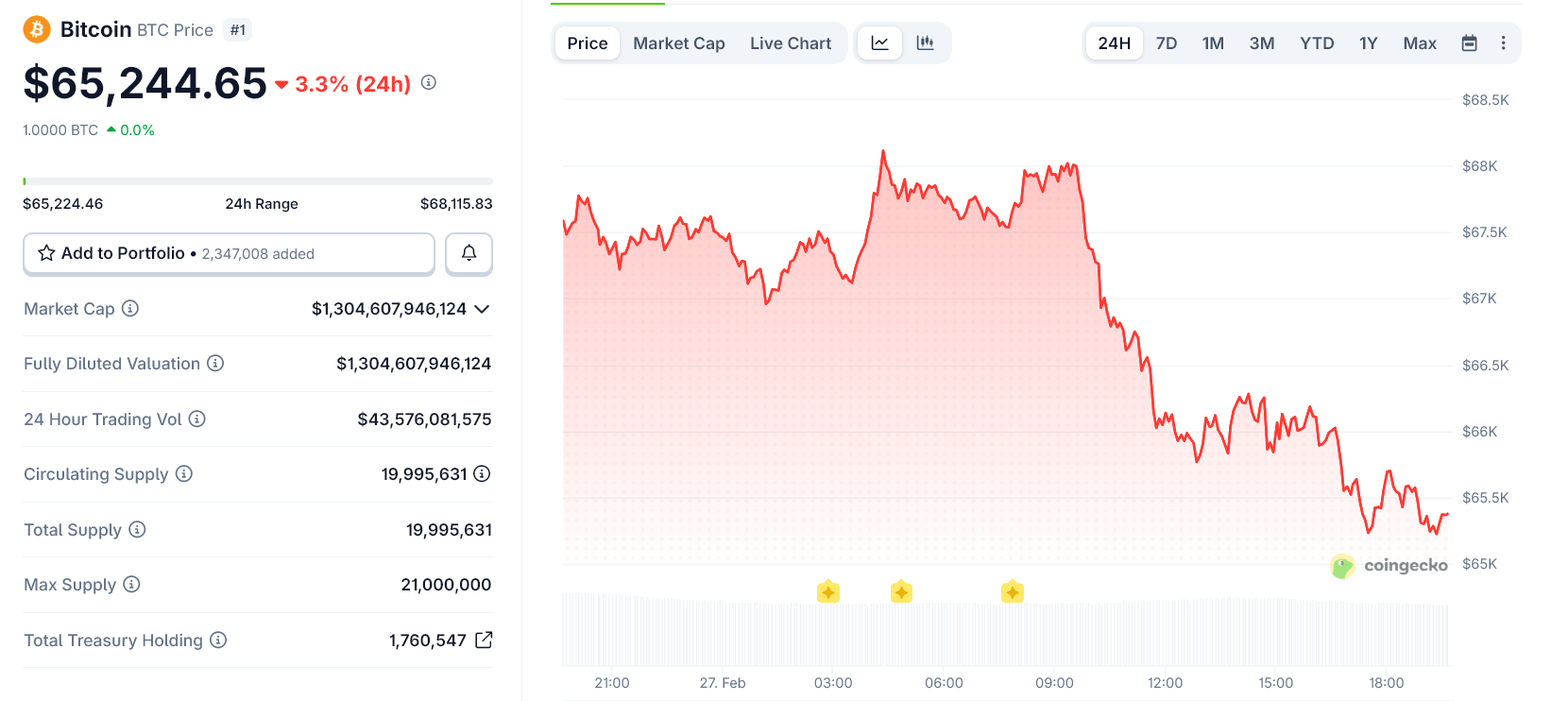
Bitcoin fell sharply on February 27 as geopolitical tensions rose, sending the price to around $65,200 after several days of attempts to recover towards $70,000. This decline came after US President Donald Trump indicated the possibility of a “friendly takeover” of Cuba, while at the same time Washington increased its military position in Israel.
Together, these titles have injected new uncertainty into global markets. The cryptocurrency market, which was stable, quickly responded to this development.
Trump said in his remarks today that the Cuban government is “in big trouble” and “talk to us”, indicating that the United States could seek a “friendly purchase”. He portrayed Cuba as suffering from financial difficulties and willing to negotiate.
These statements come after weeks of mounting pressure. Since returning to the presidency in January 2025, Trump has reimplemented and expanded the policies of maximum pressure against Havana.
In late January 2026, Trump signed an executive order declaring a national emergency related to Cuba and threatening to impose tariffs on any country that supplies the island with oil.
This action effectively led to an oil blockade. Cuba is heavily dependent on Venezuelan and Mexican fuel. When shipments were halted under pressure from the United States, the island faced frequent power outages, fuel shortages at the airport and widespread economic hardship.
Tensions have risen this week following a fatal maritime accident. Cuban forces intercepted a US-registered speedboat near its territorial waters. Four people were killed during the clash.
Havana described the group as armed infiltrators. Washington has denied involvement, but has launched investigations.
At the same time, the Trump administration temporarily allowed limited shipments of humanitarian oil through special channels.
However, broader economic pressures remain.
In view of these developments, the phrase “friendly procurement” takes on additional importance. It is more likely to indicate a negotiated political transition under American influence than a military invasion.
However, this speech is sensitive. Cuba has built its identity for six decades on resistance to American influence.
At the same time, the United States increased its military presence in Israel Escalating tensions with Iran.
Stationing advanced fighters and additional assets in the region. The State Department also approved the departure of non-essential diplomatic personnel.
Although officials describe this situation as a deterrent, markets see geopolitical risks. The Middle East and the Caribbean region are now witnessing simultaneous American pressures.
Bitcoin sought to recover $70,000 In the last few sessions. Instead, the price reversed strongly, falling more than 3% in 24 hours. This movement suggests that traders reduce their exposure to risk.
Cryptocurrencies often react to macroeconomic uncertainty in two stages. First, liquidity is tight and prices are falling. Later, if the instability persists, some investors will turn to Bitcoin as a hedging tool.
The indicators currently indicate that the markets are still in the first stage.
As geopolitical tensions develop on many fronts, the level of volatility can be high. The next movement of Bitcoin will probably depend on the extent to which diplomatic channels manage to calm the situation or if the escalation continues.